
The missiles were randomly chosen from the production stock and the entire launch activities were carried out by the specially formed strategic force command and monitored by the scientists of Defence Research and Development Organisation as part of training exercise, a defence scientist said.
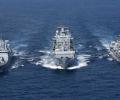
Naval assets take years to build, and therefore, not only is futuristic force planning essential, but indigenous projects must also be put into the pipeline, technologies developed and contracts for assets signed regularly so that the Indian Navy always remains a future-focussed force, asserts Vice Admiral Biswajit Dasgupta (retd).
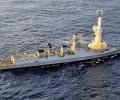
The BrahMos supersonic cruise missile is the world's fastest operational system in its class and recently the DRDO has extended the range of the missile system from the existing 298 km to around 450 km.
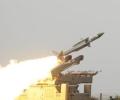
India today successfully test fired indigenously-developed surface-to-air Akash missile with a strike range of 25 km and capability to carry warhead of 60 kg from the Integrated Test Range at Chandipur as part of a user-trial.

France has asked India for early finalisation of the long-pending Rs 30,000-crore project for joint production of short-range surface-to-air missile (SR-SAM) systems.
India on Sunday successfully test-fired a new interceptor missile capable of neutralising any incoming long-range missile at higher altitude.

Astra is an indigenously developed air-to-air missile.
India is deploying cutting-edge technology to defeat a simple insurgent weapon that J&K militants and Naxals are using to lethal effect: the Improvised Explosive Device, or IED. Swedish company Saab has offered to partner India's Defence Research and Development Organisation in fitting Saab's CARABAS radar on India's Dhruv Advanced Light Helicopter (ALH), which would allow the scanning of wide swathes of territory to detect IEDs well before they can be exploded.

India on Monday successfully flight-tested its indigenously developed SMART torpedo system, which DRDO said will be a "game changer" in anti-submarine warfare, marking yet another milestone in strengthening the country's maritime strategic capabilities, defence sources said.

The Central Bureau of Investigation has arrested Delhi lawyer Gautam Khaitan in the case of alleged commission paid by Brazilian aircraft manufacturer Embraer to a UK-based NRI middleman to swing a three-aircraft deal with DRDO worth $210 million in its favour in 2008, officials said on Thursday.

Excluding the pension outgo, the allocation in the Union Budget for the armed forces stands at Rs 3.62 lakh crore.
The army confirmed that they will buy 12 Nishant Unmanned Aerial Vehicle for reconnaissance and surveillance operations, a top Defence Research and Development Organisation official said on Friday.
The indigenous Kaveri aircraft engine, soon to make its debut flight, lacks the muscle needed by India's Tejas light combat aircraft, which the engine was designed to power. In its present form, the Kaveri will never power a modern fighter. The Indian Navy is snapping up the Kaveri for powering its growing fleet of warships.

Its 'failure not just affects the military's effectiveness but could also be politically vulnerable for the BJP,' observes Ajai Shukla.

In line with the government's vision of 'Aatmanirbhar Bharat', the ministry of defence on Thursday signed contracts with Indian shipyards for the acquisition of 11 next generation offshore patrol vessels and six next generation missile vessels at a cost of nearly Rs 19,600 crore, officials said.
India will test fire its long-range surface-to-surface missile, Agni-III, by the year end and has started induction of the Agni-I and Agni-II versions in a newly raised strategic command, Dr M Natrajan, scientist claimed on Tuesday.
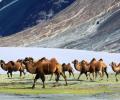
The Defence Research and Development Organisation (DRDO) in Leh has conducted research on the double hump or Bactrian camels which can carry load of 170 kilogrammes at an elevation of 17,000 feet height in the Eastern Ladakh region.

Union Home Minister Amit Shah has announced that India will soon create a comprehensive anti-drone unit to secure its borders. He highlighted the increasing threat posed by drones, especially along the India-Pakistan border, and emphasized a 'whole of government' approach to tackle this issue. Shah also spoke about the ongoing Comprehensive Integrated Border Management System (CIBMS) and the Modi government's Vibrant Village Programme, which aims to develop and integrate the population of northern borders.
As protests rage in Kudankulam and reach a crescendo, V Ponraj, scientific advisor to Dr A P J Abdul Kalam, speaks about the report he and the former Indian President prepared in this interview with rediff.com's Shobha Warrier.

The real value of the Tejas Mark 1 is the role it will now play in the development of India's next generation of fighter aircraft that will be more technologically advanced and lethal.

Agni-V is a three stage missile, 17 metres tall, two metres wide and capable of carrying 1.5 tonne of nuclear warheads.

The defence ministry took the decision to hold the biennial event as scheduled following inputs from major stakeholders including the domestic defence industry and global aerospace majors, official sources said.
The DRDO has clearly decided that developing technologies is at least as important as developing weapons systems. V K Aatre, DRDO chief from 2000-04, had said, "Weapons programmes and technologies have to maintain equal pace." Only now is the DRDO heeding his advice.

With the Indian Navy's requirement of conventional submarines standing at 24, there is critical need to expedite the planned acquisition of six more conventional submarines.
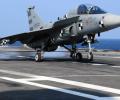
The naval version of Tejas light combat aircraft is in development stage. Officials said the successful "arrested landing" of the prototype of the naval version of Tejas on the deck of INS Vikramaditya is expected to speed up development of the jet for the Indian Navy.
India's indigenous Light Combat Aircraft Tejas has successfully completed air-to-air close combat missile firing tests, ahead of its clearance for induction into the Indian Air Force.
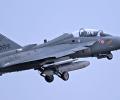
Air Chief Marshal B S Dhanoa calling the FOC a 'major milestone'.
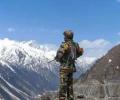
The Heron unmanned aerial vehicles are already in the Air Force, Navy, and the Army and are being used extensively at the moment by both Army surveillance and Target acquisition batteries and Air Force in the Ladakh sector.

The surface-to-surface Prithvi-II missile is capable of carrying 500 kilogram to 1,000 kg of warheads and is thrusted by liquid propulsion twine engines
Chief Controller (R&D) Dr W Selvamurthy told reporters in Bangalore that about 10 people from the US have been joining DRDO each year and the trend is growing.
The Centre for Airborne Systems, DRDO's Bangalore-based unit, has revived the airborne early warning system programme, which was scrapped in 1999 following a crash of the rotodome radar-fitted Avro aircraft near Arakkonam in Chennai.

Dr Bhabha and Dr Sarabhai didn't feel guilty for their ambitions; it was for those 'mad scientists' that India is a powerhouse -- both at the atomic level and in the vastness of space, observes Kumar Abishek.
India will join the elite club of nations having ICBM with the Defence Research and Development Organisation planning to carry out the launch of over 5,000 km-range Agni-5 missile in April.
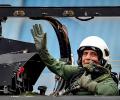
Wearing a G suit, the minister buckled himself in the seat behind the pilot in the aircraft.
With a range of 25km, Akash is one of the five missiles currently under development by the Defence Research and Development Organisation.
India is ready to export missiles to countries whose names are cleared by the government, top DRDO scientist S Prahlada has said, disclosing that trade inquiries have been received from at least five nations. Though Prahlada did not name the missiles, which could be offered in world market but sources said that India could place Indo-Russian supersonic cruise missile Brahmos and recently tested surface-to-air missile Akash for sale.
BrahMos is unique among cruise missiles due to its 2.8 Mach supersonic speed (all other cruise missiles are sub-sonic at present) and much-longer strike range.
India does not need to carry any more nuclear tests, Atomic Energy commission chief Anil Kakodkar said on Wednesday in the backdrop of the controversy over whether the 1998 Pokhran thermo-nuclear explosion was a fizzle.
'There is a change in the administration in the United States of America. They are bound to further pressurise India to sign the CTBT. In such an event it was necessary to make such a statement or speak the truth on the issue so that India does not rush into signing the CTBT.'
 © 2026 Rediff.com - Advertise with us - Disclaimer - Privacy Policy - Sitemap - Feedback - About us - Terms of use - Grievances